Aims
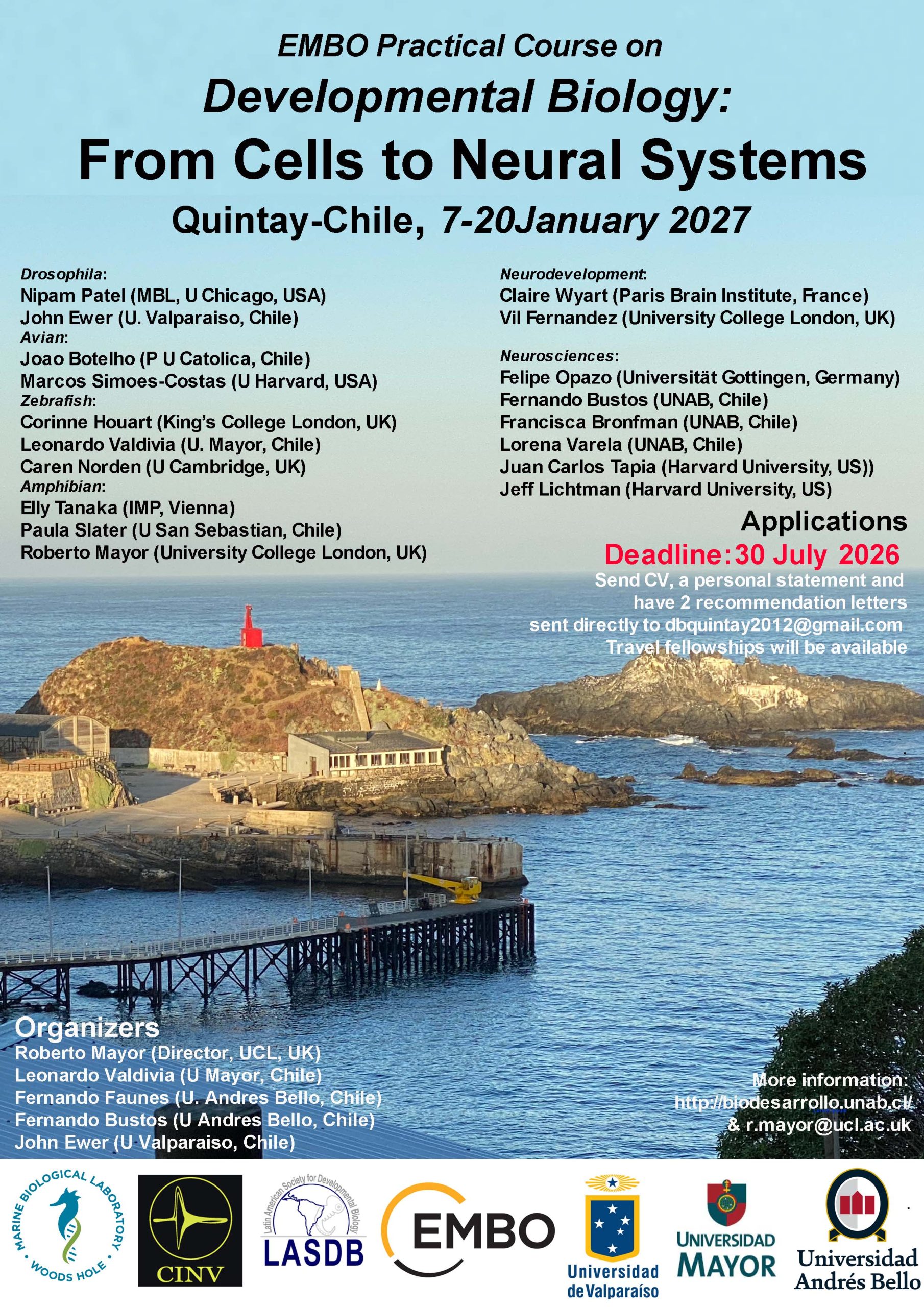
– The main objective of the course is to provide students with state-of-the-art approaches for imaging development, with a particular focus on nervous system development across different animal models. In recent years, there has been an explosion in advanced microscopy and labelling techniques, enabling the study of development and neurodevelopment in unprecedented ways.
– In addition, the course aims to foster interaction, at the bench and during lectures, between world-leading developmental biologists (see Faculty) and young investigators. An open and relaxed environment will be promoted in the magnificent Centre of Marine Biology Research (CIMARQ)
– Although the course is intended primarily for Latin American students, it is also open to non-Latin American investigators (see How to apply), to establish links and promote a culture of international collaboration that will further contribute to the field. The course will offer 6 places for non-Latin American students and 14 for Latin American students. Fellowships will be available.
Description of the course: an intensive 14-day laboratory and lecture course for advanced graduate students and postdoctoral fellows who seek a broad view of the modern issues of Developmental Biology and Developmental Neurobiology. Exceptional Latin American undergraduate students may also apply.
Related lectures and laboratories will provide the student with the state-of-the-art of paradigms, problems and methodologies on modern Developmental Biology and Developmental Neurobiology. The animal model used for laboratories will be zebrafish and locally available fishes; insects (Drosophila and others); frog, chick and cells in culture.
Laboratories will include embryological manipulation (cell ablation, tissue grafting), molecular genetic (RNA microinjection, electroporation) and cell biology approaches (cell lineage and migratory behaviour).
The students will present their current research in an informal and relaxed environment at the end of each day (see program)
Mini-Symposium: In addition to the course, a Mini-symposium will be organised at CIMARQ. The Mini-Symposium will last one day, and it will be open to everybody with previous registration.